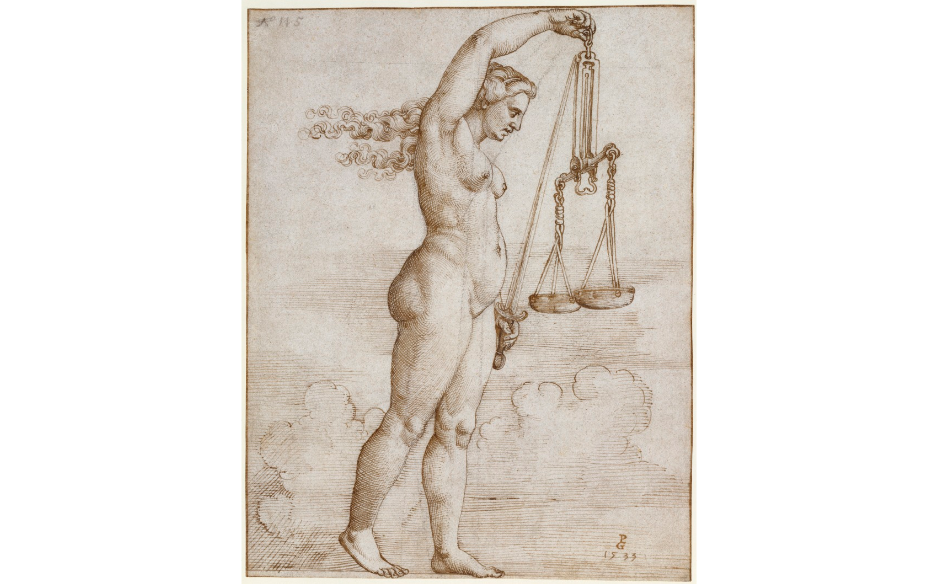
This event is actually my favorite touristy site here in LA which is the Getty Museum. Not only are there beautiful views of LA, but there is a wide variety of art. My favorite type of art is drawings because there is so much detail that goes into it, not only in terms of lines but shading etc. So it was only fitting that this was my first stop when I arrived. One piece of work that caught my eye was the Allegory of Justice by Georg Pencz. This piece is relative to the course because the lines and proportions of the the woman and the scales have been paid great detail. This is similar to the lectures on math and art. It also goes back to what was described in the lecture as a one point perspective that conveys 3D space on a 2D canvas. In researching him, it was interesting to learn that he was actually well-known as a painter who was one of the “godless painters” who did not believe in baptism or transubstantiation.
 Another exhibit at the museum was the Light, Paper, Process: Reinventing Photography. This exhibit takes the work of 7 artists who experiment with different “light sensitivity and chemical [processes] of photographic papers, challenging us to see the medium anew” (Light, Paper, Process: Reinventing Photography). We are always trying to find new ways to manipulate the materials around us to create new forms of objects and substances. In researching one of the artists, James Welling, I found that he was the head of photography in the Department of Art for a brief period of time. His photography ranged from light sources to abstractions to tiles. Welling was interested in in creating new mediums and new ways of interpreting objects around us.
 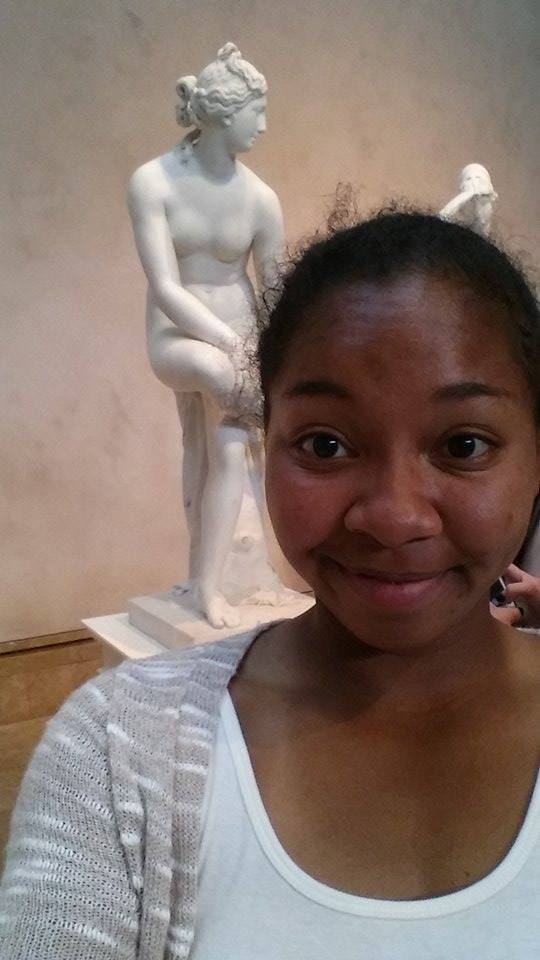 Another interesting piece that I saw was of the Greek goddess Venus. It wasn’t necessarily the sculpture that intrigued me but as I was looking at it, I thought back to the lectures on nanotechnology. I remembered that porcelain along with glass and other materials that I was seeing contained nanoparticles. To actually see this was strange to me because it’s still hard for me to wrap my head around the idea that in a time when we today would have thought had limited resources, actually had advanced technology. I did some research into the sculptor, Joseph Nollekens. He was most known for his portrait busts and dabbled in the styles of Baroque and Classical Roman sculpture.
As I mentioned, the Getty is my favorite site here in LA. I would recommend this event to anyone not only for the art and the views, but also the beauty of the garden down below. I’ve been several times and found it to be the prettiest in the fall and winter when the leaves turn brown.
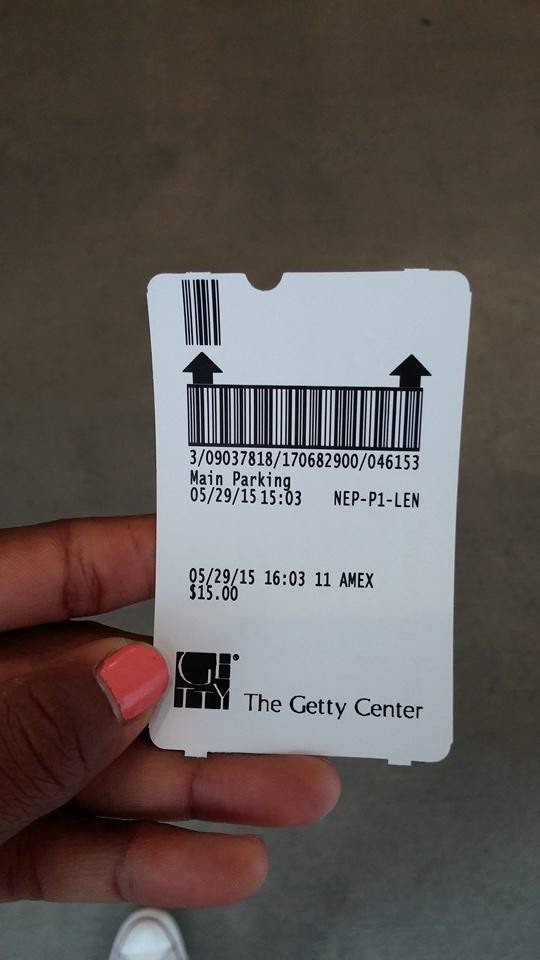
Proof the I attended the event:

Bibliography
"Georg Pencz (German, 1500-1550): Original Engravings." Georg Pencz (German, 1500-1550): Original Engravings. Spaightwood Galleries, 7 June 2015. Web. 10 June 2015. <http://spaightwoodgalleries.com/Pages/Pencz.html>.
"The Getty Museum." Getty Museum. J. Paul Getty Trust, n.d. Web. 10 June 2015. <http://www.getty.edu/art/exhibitions/process/>.
Gimzewski, James K. "Nanotech Jim Pt4." YouTube. YouTube, n.d. Web. 10 June 2015. <https://www.youtube.com/watch?v=yHCuZetAIhk>.
"James Welling." James Welling. N.p., n.d. Web. 10 June 2015. <http://jameswelling.net/biography>.
"Joseph Nollekens (1737-1823)." Joseph Nollekens: Neoclassical Sculptor, Biography. Visual-arts-cork.com, n.d. Web. 10 June 2015. <http://www.visual-arts-cork.com/sculpture/joseph-nollekens.htm>.

No comments:
Post a Comment